
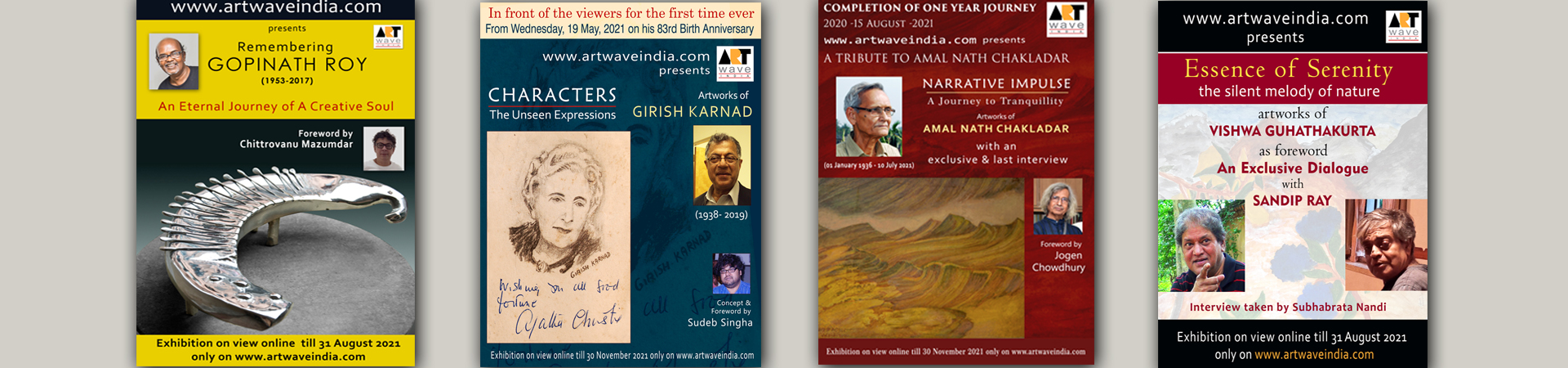
Master-Strokes
Sudeb Singha
[In the 1960s and 70s, Girish Karnad (19th May 1938 – 10th June 2019) emerged as one of the major playwrights of post-independence India who, along with contemporaries Badal Sircar, Vijay Tendulkar and Mohan Rakesh, redefined Modern Indian Theatre. For almost sixty years, Girish Karnad consistently critiqued existing social norms and customs as much as he critiqued urbanization through his plays. At the same time, he kept experimenting throughout, choosing from a remarkably wide array of styles and forms.
Girish Karnad is a playwright whose plays offer a re-engagement between the apparently separated worlds of ‘drama’ and various other kinds of performative domains like dance, mime, puppet show, etc. and make the autonomy and accessibility to drama and theatre complimentary rather than contrasting domains. Even though most of his plays are based on our folktales, myths, episodes from our epics and from our history, Girish Karnad had an extraordinary ability to make the contemporariness of his plays palpable even as the reader/spectator was captivated by the tale itself, the characters – complex, bold, tragic, the dialogues and monologues they spoke and the sheer craft of his narration. His plays figure widely in university syllabi around the world to be taught in classrooms as texts, while they are equally popular as performance texts, produced and re-produced time and again by different directors. Karnad’s plays are successfully performed by theatre groups of different countries and are extremely well received by the audiences of different cultures. Without doubt, he is one of the tallest figures of India’s cultural modernity.]
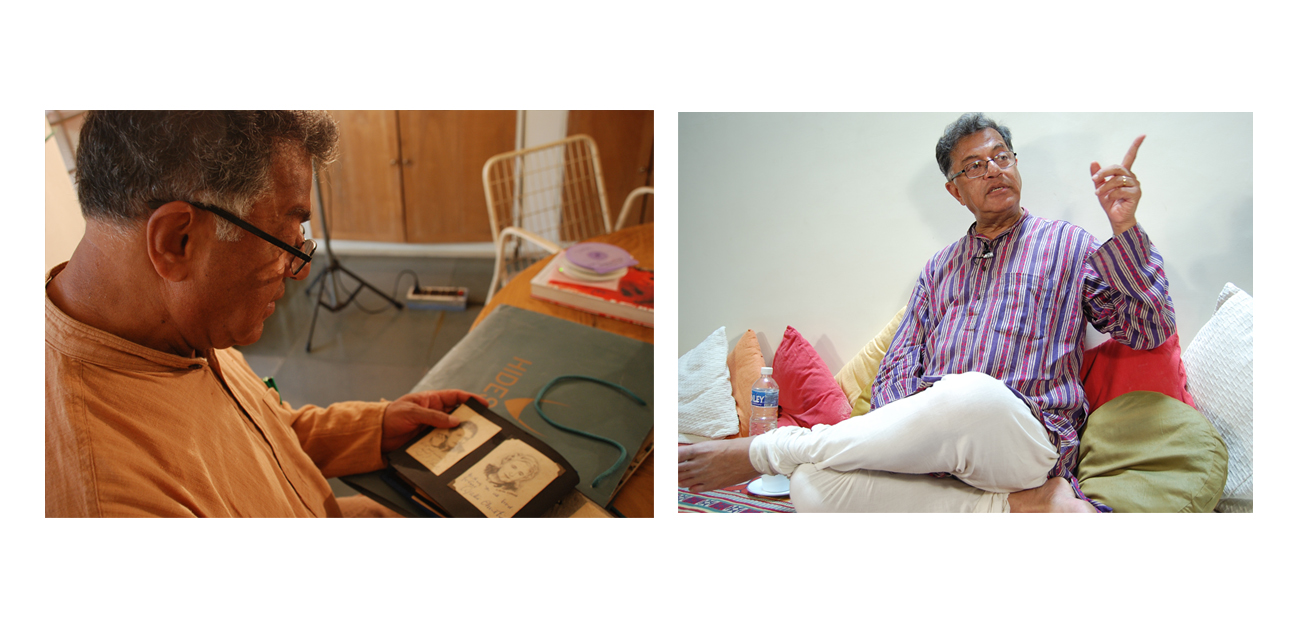
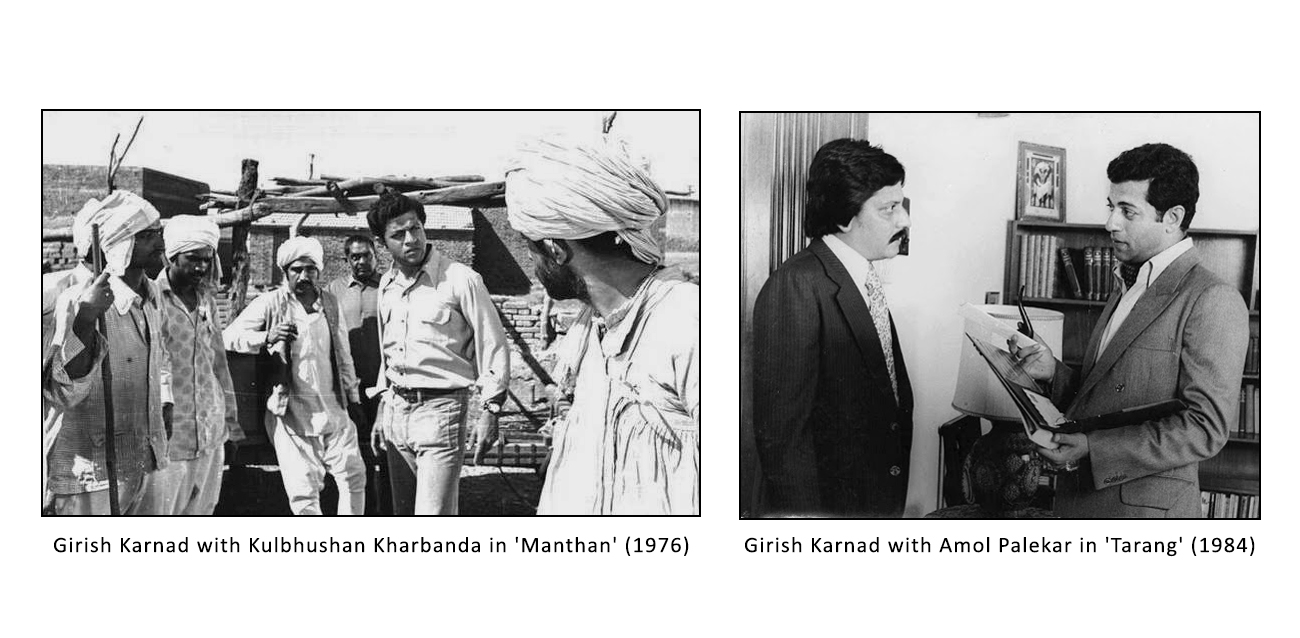
It is well known that Girish Karnad was not only a legendary playwright, but as an actor, director and most importantly as a screenwriter, he was also one of the major figures in the golden age of Indian parallel cinema. Besides, he also directed two plays – Badal Sircar’s Ebong Indrajit in English (his own translation) in the early 1970s and his play Bikhre Bimb in Hindi (2005). However, not many people know that he was trained in the Tabla, besides being trained in Hindustani Classical music and Hindustani Classical Dance. Even fewer people know that from a very young age, Karnad used to be very fond of drawing and sketching. He would sketch portraits of his icons and heroes. He was pretty much self-trained, though one might think otherwise after going through his sketches, most of which are striking as portraitures. Later, while studying at the Oxford University as a Rhodes Scholar, he would come across several of his icons, many of whom he convinced to sit so that he could sketch them. On occasions, he would get the sketches signed by his subjects, some of them being as famous as Agatha Christie, W.H. Auden and T.S. Eliot. Karnad’s sketches not only talk of his fascination for personalities who excelled in fields as varied as literature, theatre, history, mathematics, philosophy, mountaineering, etc. but also give us an idea of his dexterity as an artist. The portraits also reveal a lot about Girish Karnad the individual. I am tempted to quote Basil Hallward, the poor artist in Oscar Wilde’s The Picture of Dorian Gray— ‘every portrait that is painted with feeling is a portrait of the artist, not of the sitter.’
Despite Karnad’s interest in various fields of excellence, there is but (at least) one common factor which comes through in his drawings— his obsession during his younger days with all things European when it comes to literature.
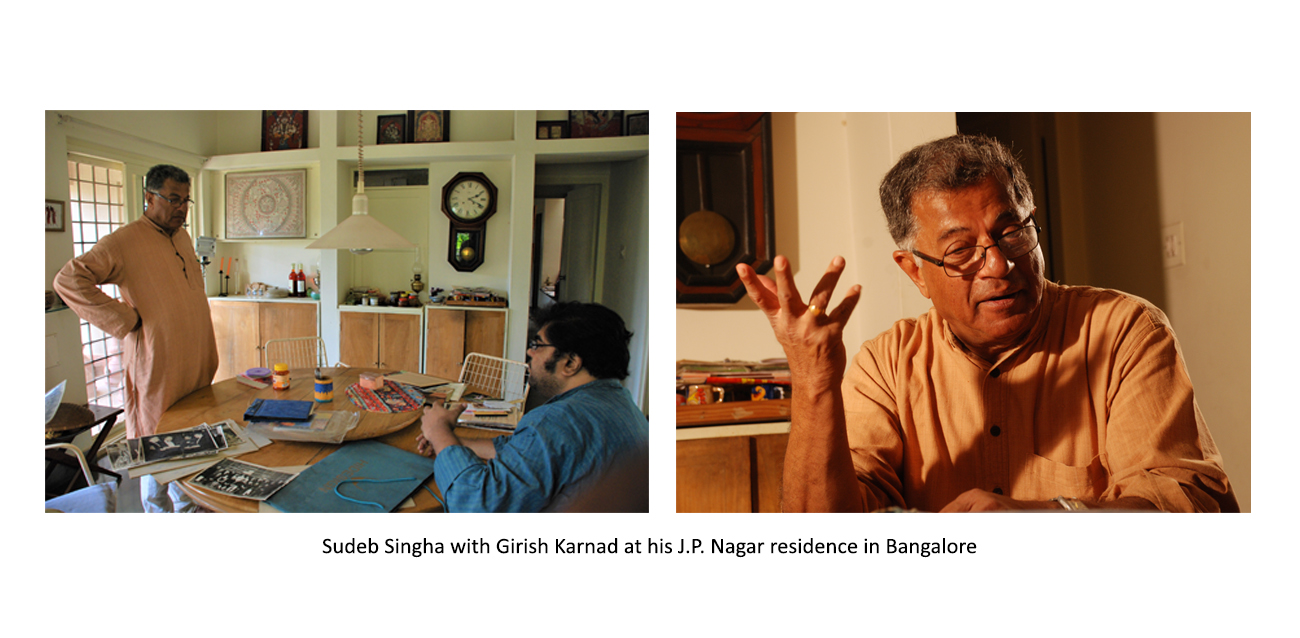
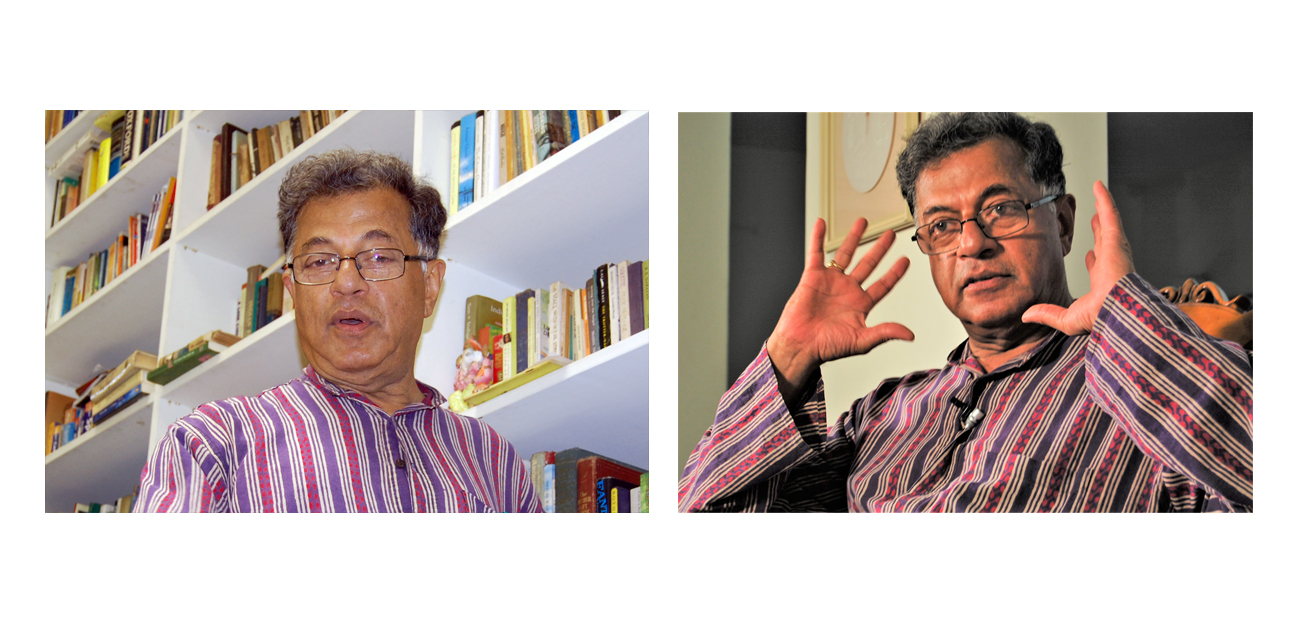
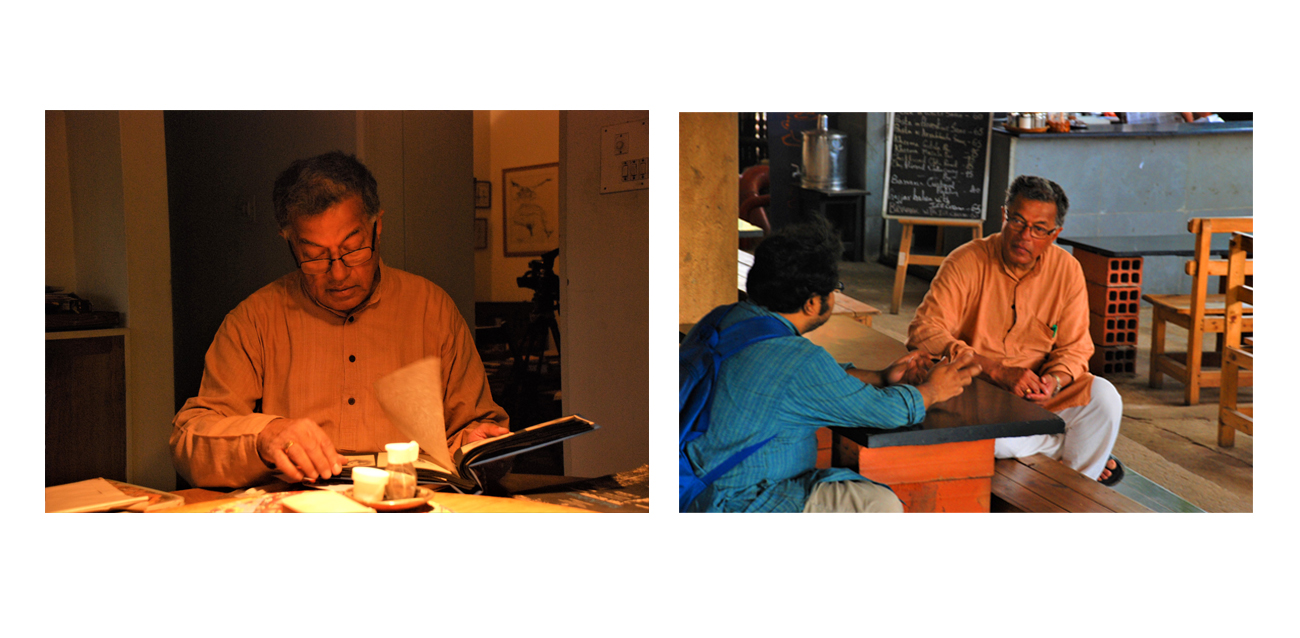
In the year 2009, I started shooting my audio-visual project on Girish Karnad in his J.P. Nagar residence in Bangalore. He had agreed to be the subject of my project after reading the project ideation I had sent him. He was more than gracious in spending hours after hours with me over the course of four years, talking at length on various topics concerning mostly theatre and his plays, but also cinema, his love for literature and history and his childhood, among countless other things.
Karnad grew up in Sirsi (a small village in Karnataka) watching folk theatre and performances by travelling natak companies— often through the night. His father being a government doctor meant that the whole family would get free passes from the travelling groups. He would go with his parents and watch, for instance, the Sampoorna Ramayana which would run for the whole night.
‘I saw Yakshagana with the servants, I saw Company Nataks which used their own dynamos and gaslights to start their plays… I have seen the whole history of Natak Companies,’ Girish Karnad said during one of the shooting sessions. ‘I have seen the time when in Kannada, men used to act women, around 1942-43,’ he continued. ‘I have seen a time when there used to be no electricity, and gas lamps were used by the travelling Natak groups, [there were] curtains which used to go up and down… then I have seen electricity being used, before going to London where I saw theatre like mad… So, I have been fortunate enough to witness the whole technological history of theatre.’
One could be excused for thinking that by the time Girish Karnad started writing plays, he was pretty much entirely one with his linguistic and cultural roots. After all, in his own words, he ‘was crazy about theatre’ right from the time when he had started watching folk theatre and Company Natak in Sirsi. Karnad’s mother tongue was a dialect of Konkani different from the official Goanese dialect, while he grew up speaking, reading and writing Kannada and Marathi, along with English and Hindi. When I had asked him what he considers to be his identity as an artist, he had said that he always thought of himself as a Kannada playwright above anything else. After his play Tughlaq was published in1964, it was criticized by many Kannada purists who said that the language he used in his plays was an ‘anglicized’ version of Kannada. This made him devote his energies into ‘getting his Kannada right’ first. He expanded his horizons of the language of his childhood (Kannada), giving it precedence over the acquired language of his adulthood (English), by routinely indulging in conversations with Kannada friends and acquaintances, and getting involved in regional film projects in some capacity so that he could challenge himself to perfect unknown dialects of Kannada. It just goes on to show that like any true artist, Karnad too attached a lot of value to the language of his cultural roots. And yet, there was a time when he used to believe that all things ‘great’ in literature happened in the ‘West’, especially England. Now, how does one explain this contradictory trait in him?
The 1950s were a time when the country, although fresh from being free of the British imperialists, was still only beginning to find its own composite identity. In most of the schools in or around the cities – the ones which the middle-class families could afford – the Indian teachers who taught English were almost at par with British teachers. It is not hard to see why: they had received their education in colonial India. As a result, one was growing up during the 1940s and 50s in an India free of the British Raj but not free of the colonial influence as far as education was concerned, particularly when it came to English as a subject. In terms of pedagogy or formal education, English was synonymous essentially with Britain and the language the British spoke.
The rationalism in the enlightenment age that dominated nineteenth century Europe, also dominated English education in post-colonial Indian cities and towns. Literary works coming out of Latin America, Africa or countries like Turkey or Japan would take another few years before reaching the sub-continent reader. Frantz Fanon was yet to write The Wretched of the Earth (1961) and Edward Said’s Orientalism (1978) was yet to take the academic circles by storm. England and other parts of Europe were still ‘the be all and end all’ of world literature. Since English was the language connecting India to Europe, it was only natural that the fascination for Europe as a whole in the minds of the Indian student was first and foremost reflected in the fascination for English literature. Girish Karnad was no exception, despite his humble upbringing replete with rich visual and aural experiences of watching folk or local theatre. He used to write English poetry in college and (like many in those times) believed that writing in English alone would get him international acclaim. In fact, such was his obsession with the idea of reaching ‘the land of Eliot, Auden and Yeats’ (as he used to say) that he chose mathematics and statistics as his subjects in B.A. (Karnataka University, Dharwad) and mathematics in M.A. (Bombay), for he had figured out that getting a first class first in mathematics would be far easier, as opposed to history or literature, and that would enable him to go abroad. However, before completing his M.A. in Bombay he received the Rhodes scholarship. As a Rhodes Scholar he went to England to pursue his M.A. in philosophy, political science and economics at the Oxford University (Magdalen). In England, Karnad would see ‘brilliant Shakespeare’, apart from productions of plays by Brecht, Shaw, Osborne, Beckett, Anouilh, O’Neil, Greek plays, etc.
It is worth mentioning though, that just before leaving for London in 1960, he had completed writing the first draft of his first play Yayati, in Kannada. He was all of 22 at that time. It was published in 1961.
During the two years he spent in Bombay pursuing his M.A. (1958-59), Karnad saw as many kinds of plays as he possibly could. Prithvi theatre, Marathi Company Natak, Gujarati theatre, Parsi theatre— he saw it all. In this phase, he was particularly fascinated by Ebrahim Alkazi’s English productions of European playwrights like Strindberg, Jean Anouilh, Ibsen, Chekov, Sartre, etc. Seeing Alkazi’s productions had a tremendous impact on him. Now he could view the whole Mediterranean on the world map without focusing all his intellect only on England or English playwrights like Shaw and Osborne (although the plays were, quite understandably, in English). It was after seeing Alkazi’s productions of plays by Anouilh, Sartre and Giraudoux and reading French playwrights like Anouilh and Cocteau that he derived the idea of using myths in plays and also learnt how to use them effectively for a modern audience.
For Yayati he chose an episode from The Mahabharata but narrated it using dramatic and structural elements he had seen in Alkazi’s production of Jean Anouilh’s Antigone. For instance, Yayati is full of scenes with ‘big one-to-one confrontations between two characters’ and has strong ‘venom-spewing’ women characters – features which, in his own admission, were directly influenced by Anouilh’s Antigone. However, it is worth mentioning again that, despite his fascination for Alkazi’s English productions and his obsession for ‘the land of Eliot and Auden’, he wrote his first play in Kannada.
Between 1960 and 1964, Girish Karnad wrote three plays for the stage – he published only two of them at that time – and one play (Ma Nishada, 1964) for the radio. This was a particularly interesting phase in Karnad’s life. Before Karnad returned to India and wrote Tughlaq in 1963-64, he had already started working on the first draft of Anju Mallige. It was based on some of the experiences he had in England which had left a profound imprint on him. The final draft was written and published only in 1977. Anju Mallige had from the beginning been conceived as a play set in England about non-resident Indians (non-white ‘outsiders’) who had started settling in England looking for greener pastures in the post-colonial period. Although there are more than one sub-texts underlining the play, the central themes which have been explored herein are human desires and motivations, sexual tension and envy, and possessiveness. Karnad opts for a much more complex and multi-layered approach in Anju Mallige as compared to Yayati. In Yayati, Devayani and Sharmistha try to establish their superiority over each other using sexual prowess as an instrument. In contrast, the sexual tension in Anju Mallige unravels itself only gradually as the play progresses. In Tughlaq, the sexual connotations are even more complex in fabric.
During one of the sessions with me (while shooting for my project), Girish Karnad revealed that in the initial drafts of Anju Mallige there was a character who stays in England but finds it too gloomy too often, which arouses sexual desires in him. This character (who is not the protagonist) wants to establish a distinct identity of himself among his acquaintances (British, other Asians, Africans, etc.), especially before this bright and ‘extremely well-read’ girl he is attracted to. However, he is shy and speaks little. But he loves to write. He is a voracious reader and loves to sketch and paint. Karnad’s initial drafts had descriptions of the character’s paintings and sketches, the bold, deep strokes and flourishes in them, signifying expressions of intense sexual yearning.
Girish Karnad would alter much of this character in the following drafts to avoid obvious comparisons with himself. However, it is quite assumable that initially he wanted to portray a character very similar to himself: someone who expresses himself through written words and through pencil or brush strokes.
(Sudeb Singha has been working with Girish Karnad for almost four years. 2009 to 2012. There are thousands of such topics in audio-visual format. Girish gave every sketch to Sudeb Singha. He also has authentic documents. He is the key person behind this exhibition titled ‘CHARACTERS’- The Unseen Expressions. All these artworks of Girish Karnad are NOT FOR SALE.)