

The kaleidoscope of khwaabgaon
Mrinal Mandal

Since 2012, Chalchitra Academy has been working to build a bridge between folk and urban artists all over West Bengal and India while simultaneously searching for the historical roots of the varied forms of traditional art-forms. It has been informing artists, students, and amateurs alike about the archaeological, cultural, and artistic values of lokaja and bhumija artistry through organising successive workshops in Kolkata and other districts. Those have entailed discussions about folk-art, displaying the folk-artists at work, and organising exhibitions. The academy has so far come a long way without any government or corporate aid, sustained from the sheer urge to disseminate the artistic knowledge to build a better future.
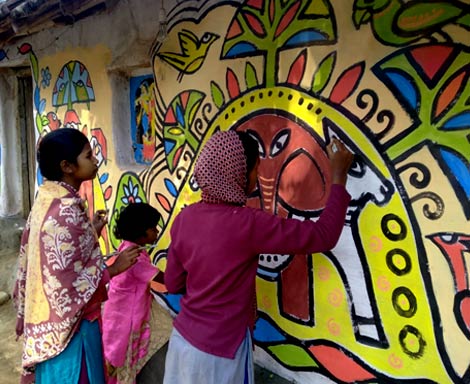
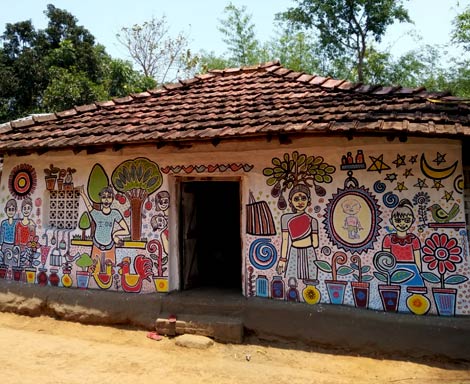
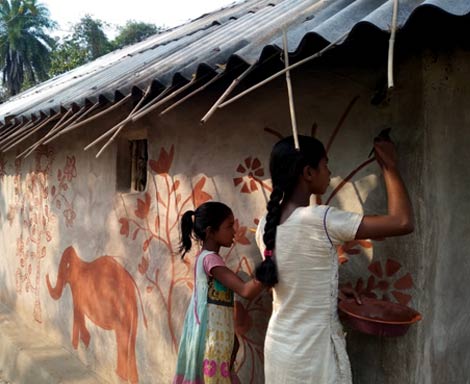
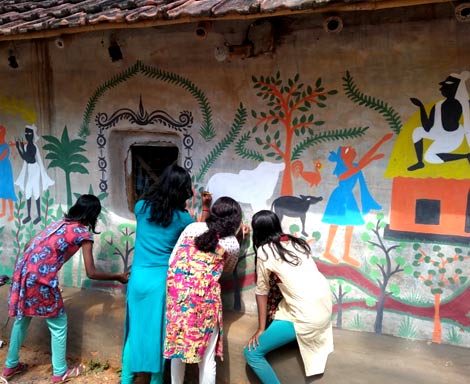
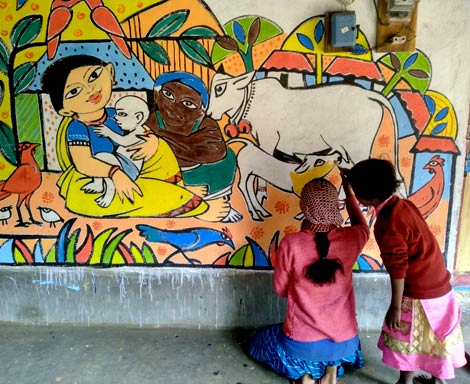
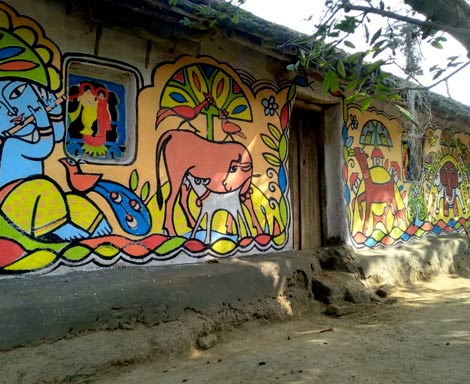
The initiative of Chalchitra Academy, is a collaborative effort amongst friends, artists and scholars alike, that we ventured 5 km outside the Jhargram town into the annals of the Junglemahals. There, in a small village inhabited by people hailing from the Lodha tribe we have started setting up site specific art-projects along with capacity building through initiatives in vocational education. Erstwhile named as Laalbazar, the famous scholar and writer Shivaji Bandopadhyay gave it the moniker of Khwaabgaon and from thence on Chalchitra Academy has envisioned to include each and every adult and child in that project to create a holistic sociocultural outreach. A picturesque hamlet surrounded by Shal, Mahua, Polash, and steeped in abject poverty, Laalbazar was originally set-up some 70-80 years ago as a farmland for the Malla Ugal Shandadev dynasty of Jhargram. But, owing to the Criminal Tribes Act (passed in 1871 and then extended to cover the erstwhile Bengal Presidency in 1876) and also due to the socio-political denigration and ethno-economic segregation faced in the hands of larger socio-cultural forces, the members of the Lodha community has always faced an inhumanly uphill struggle to make both ends meet and lead respectable lives. This project is thusly an earnest promise to remedy that situation as deeply and permanently as possible. Artists from all backgrounds have stepped in to provide their craft and expertise. The famous artist and Rajya Sabha MP Jogen Chowdhury have even created a logo for this project. Each Saturday we organise free classes on painting, sculpture, quiltwork, kutumkatam, etc. along with teaching the kids how to meditate. Local artists Rameswar Soren and Jodeswar Hansda are involved with the project. All the walls in the village have been covered up by humongous and mesmerising paintings done by various artists over the course of multiple workshops. With each passing day more and more artists, both traditional and contemporary, from cities, towns, and other villages alike have come to work with and for the villagers of Khwaabgaon
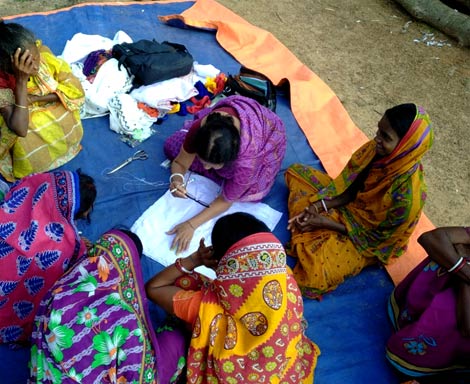
Bidhan Biswas, the much acclaimed alpana artist from Krishnanagar had come to Khwaabgaon to teach the villagers how to use chalky soil to create intricate designs on red laterite soil upon the chitrapatas and the walls. Through a collaboration between Chalchitra Academy and Lalit Kala Academy, such traditional patachitra painters as Manu Chitrakar, Bahadur Chitrakar, Dukhushyam Chitrakar, and Swarna Chitrakar came from Nayagram to show them how to extract natural pigments and gums from leaves, flowers, tendrils, etc. and how to use those to create geometric and floral patterns on chitrapatas. Jayati Banerjee, the famous designer from Kolkata who is also the co-founder of Chalchitra Academy, has been taking classes to teach various forms of stitching and quilt work. Another designer, Paramita Kar Chowdhury, has taught the villagers the tenets of eco-print by using flowers, leaves, fruits, soil, and rusted metal-parts to create eco friendly pigments used for creating vivid designs on cotton-based fabric.
In a multi-disciplinary art-project named Sanglap Parva 1, three artists, formerly students at Kala Bhavan, Santiniketan, came to collaborate with the villagers and create art-works using various material and inspirations from the village environs. They were Nitish Kumar, Upama Chakraborty, and Deepanjan Paul. Yet another ex-student from Visva-Bharati, Babli Paul, later arrived to paint an enormous picture using the walls of a hut as her canvas. Then there was Ankita Shaw, a student of the Govt. Art College who worked along with the village-kids to paint graffities on another wall. Other than these artists from Santiniketan, there were artists like Gopal Chandra Naskar and Rajkumar Baidya who painted graffities on the walls of Khwaabgaon But, perhaps the most mesmerising of the lot was the artist Koustabh Chakraborty, whose brush endowed the walls with subjects varying from figments of rural life to stylised paintings of Tathagata Buddha, spreading a deep vibe of bliss, love, and beautiful wisdom. All these had immensely influenced the village kids who had taken up painting themselves and had covered many a walls with their own blooming artistry.
Last winter Laalbazar witneseed a folk-festival titled as Khwaabgaon Parban. Countless artists and enthusiasts arrived to take part in the myriads of workshops dealing with lokaja art-forms, discussions, musical revelry, and a grand feast. Chalchitra Academy attempted at reviving Chhang, an ancient performative art-form of the Lodha tribe, by organising a workshop portraying this rich heritage of dramatic singing and dancing that uses miniature madals and another percussive instrument, named Changu, which is said to be unique to the Lodha community. The last year also saw programmes where Chalchitra Academy planted more than a hundred trees and distributed clothes to the villagers that would suffice for an entire year. Additionally, there had been systematic drives at increasing the rate of literacy.
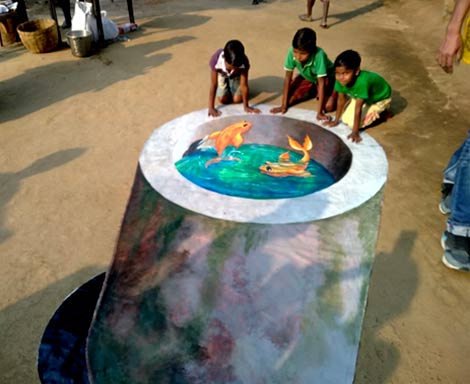
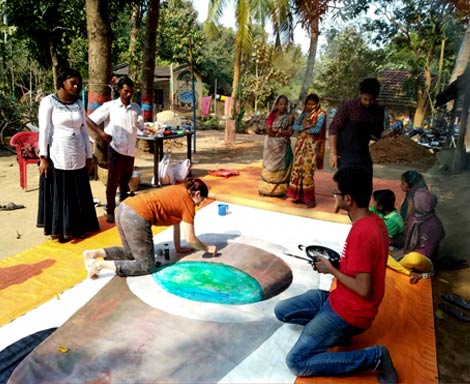
This year started off with the international workshop "Sanglap Parva 2: Exploring the margin" where the artists Tracy Lee Stum and Sayak Mitra arrived from the USA. With an active participation of the children of Khwaabgaon and neighbouring Jhargram, Tracy delved into the magical world of 3D painting. For the rest of this year up till the current lockdown was enforced to combat COVID-19, Khwaabgaon saw a steady stream of endless artists, scholars, activists, and enthusiasts who toured across the landscape, marvelled at the artworks, interacted with the villagers, provided their own inputs at socioeconomically bettering the rural life, and lauded the organisers and village elders with precious words of appreciation and encouragement.
As this project entails a holistically sustained dialogue between the rural and urban communities working towards a financial upliftment of the former through the agency of art and craft (essentially a marriage of the folk and the contemporary traditions, i.e. a confluence of the lokayata and the cosmopolita), it might be termed as a public art project. Day and night the villagers are living inside a world of artworks, almost regularly they are entering into conversations with the visiting artists and activists. Their entire existence is experiencing an artistic rejuvenation, their lives are becoming a invocation for a kaleidoscope of varied art-forms, their economic condition is seeing a steadying tide of betterment. Chalchitra Academy has even encouraged the villagers to cultivate medicinal plants like Tulsi, Basak, Aloevera, etc. as viable cash-crops for the herbal medicinal industry. All in all both the rural and the urban worlds are gaining from each other symbiotically. This is nought but an ever-evolving organic gallery. We attempt to create an expansive open-air diorama of sustained development. Each year the walls of the huts are getting decked up in newer paintings and graffities. Puja, Deep, Kiran, Shubha, Saptika, Priyanka, and all the other kids of the village are experiencing first-hand the reincarnation of their quaint hamlet. Their boundless joy and active participation is perhaps the only dividend that matters after all. Shashthi Charan Ahir, a specially-abled man from the village has been an artistic workhorse in his creation of endless examples of Kutum-Katam. Tourists from all over West Bengal and India are coming in to purchase this and other examples of artistic items. Durga, Kajol, and other women of the village are getting increasing numbers of orders for exquisite quiltwork, goyna-bori, and eco-printed dresses. Schools from all over West Bengal are organising excursions for the students to come to Khwaabgaon, collaborate with the village children, and experience this magical project of ours. An up and working wall magazine is just a token proof of this wonderful syncretism. Nabin Ahir, the aged chief of the village has been exceptionally supportive of our work and has proudly been witnessing how Chalchitra Academy has been slowly but steadily transforming the entirety of the landscape inside and out.
The members of Chalchitra regularly visit and stay at Laalbazar over the course of the monthly workshops that they organise. The kids of the village are taught by Amrita Mondal, a professor from the Basanti Devi College, Department of Chemistry. Sujata Tarafdar, a professor from Jadavpur University, Department of Physics, has helped to set up a burgeoning library for the kids. Chandana Ghosh, a Geography teacher, has bought for them a globe. Whenever she gets the chance, Jayati Banerjee comes to teach Buddhist meditation to the kids and the elders alike. Moreover, students and scholars like Archana, Soma, Riti, etc. from different universities visit Khwaabgaon at every possible chance they get to teach the children.
This enormous project has been undertaken by Chalchitra Academy without even an iota of help or support from any sources whatsoever, government or private. Their members, collaborators, and a steadying number of enthusiasts have made it possible for this flow of activities to sustain itself seamlessly. Working as mentors, this project is being categorically documented by Soujit Das, Assistant Professor of Art-History from Govt. College of Art & Craft Calcutta, and Shubhankar Das, a researcher, art-writer, and scholar from Jadavpur University. It is but a cumulative effort of all of them that has made this open-air organic studio-cum-gallery possible. Lastly, with an everlasting pledge to work holistically for the environment and the lokayatik life through art, craft, and sincere dedication, it's our heartfelt wish to welcome everybody to Khwaabgaon.

Mrinal Mandal is a practicing Artist. His research work for last 20 years is on indigenous art of different communities. He is the founder member and secretary of Chalchitra Academy, based in Kolkata